
Access Control and Surveillance Security Systems
We provide advanced access control and surveillance security systems to safeguard.
There are many different types of access control systems for commercial buildings and businesses, but not all systems will be the right fit, depending on the size of the deployment, the number of users and entries, and the level of security required. For example, a single office inside a commercial building will need very different security controls than a hospital or large warehouse facility. So, how do you know which access control system is best for your space?
- Design
- Installation
- Maintenance
What are Access control systems?
Access control systems are a type of physical security that limits access to a building or space to only authorized individuals. In a commercial setting, access control systems are most often used for building and office entries, securing IT server rooms or storage closets, and to control elevator or parking garage access. A traditional lock and key system is the most basic form of physical access control. However, today’s access control systems are much more advanced, providing improved security for commercial buildings, and better user experiences.
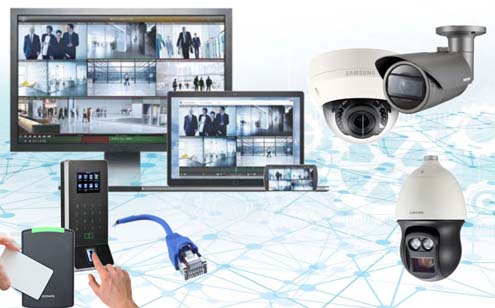
Access control systems provide an automated way of controlling who has access to certain areas within a facility. Video surveillance offers the ability to monitor those areas in real-time, ensuring that only authorized individuals are granted entry. By combining these two technologies, organizations can create a secure environment with improved visibility into the activities happening on their property.
Why integrating access control and video surveillance is a great choice for businesses.
- Enhanced Security
An integrated system provides an extra layer of protection, as it combines the capabilities of both systems. Video surveillance monitors potential security threats and records vital footage, while access control authorizes entry. The synergy between the two systems ensures buildings are constantly monitored, and only authorized personnel have access to certain sensitive areas of the facility. This keeps valuable assets secure from theft or damage. - Centralized Monitoring
Integrating access control and video surveillance allows operators to see everything at once instead of having to switch between multiple systems or screens. This allows for easier management and operation from one interface, making it more efficient and user-friendly.When all security systems are integrated and monitored centrally, it becomes easier to respond to incidents quickly. If an unauthorized access attempt is detected, the operator can immediately review the associated video footage and take necessary action, reducing the response time significantly.
- Customization and Flexibility
Integrated security systems offer a high degree of customization and flexibility. Depending on specific security requirements, alerts can be set up for certain events, such as when a user enters a high-security area or if there’s an unauthorized access attempt. Furthermore, the system can be scaled easily to accommodate growth or changes in the facility’s security needs, making it a future-proof investment. - Free Up Personnel
Integrating access control and video surveillance systems can help businesses free up valuable personnel by automating manual security processes including tasks such as opening doors, letting visitors into restricted areas, verifying employee identifications, and more. - Save Money
Having an integrated access control and video surveillance system can help save businesses money in the long run. A single system eliminates the need to purchase two separate systems, saving businesses time and money. While integrated systems may seem more expensive upfront, they provide long-term cost savings like lower maintenance and upgrading costs, and reduced insurance premiums. - Data Integration and Intelligent Reporting
When access control and video surveillance are integrated, they can share and correlate data, providing a more holistic view of security events. For example, in case of an access event, the system can pull up the related video footage, time logs, and user credentials, providing a complete picture of the incident. This integration of data can also facilitate intelligent reporting, helping to analyze trends, identify potential vulnerabilities, and demonstrate compliance with security regulations.


